
Celebrating Marie-Ann Hill
Marie-Ann’s story illustrates Swedish immigrant struggles in adapting to life in America. Her family’s story parallels and is part of a large California and American history, from the Great Depression, World War II and its aftermath, and the rise and fall of commercial ventures in Oakland, California.
-
 Marie-Ann Hill with Tegner Chair Ken Weissenborn
 -
-
Adapted from an interview for the Swedish History of the East Bay Project funded by the Barbro Osher Foundation.
-
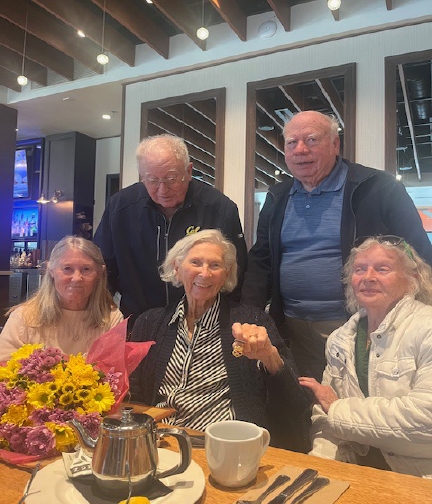 Marie-Ann displaying her VASA pin with (left to right) Mimi Hotterman, Ken Weissenborn, Marie-Ann Hill, Bob Homer, Ingrid Andersson.
 -
-
On February 19, members of Oakland, California’s Tegner Lodge #149 met at Jack’s Restaurant in Newark to celebrate Marie-Ann Hill’s 94th birthday. Unbeknownst to her, she was also being recognized as a member of VASA for 60 years. Marie-Ann’s story illustrates Swedish immigrant struggles in adapting to life in this country. Her family’s story parallels and is part of a large California and American history, from the Great Depression, World War II and its aftermath, and the rise and fall of commercial ventures in Oakland.
Her story also reflects the role of the Church of the Latter-Day Saints in promoting the mass immigration from Sweden to the United States where the religion was tolerated. Once arrived in America, a series of supportive networks of family and friends eased the transition to American citizenship: first the Mormon community, followed by a series of VASA lodges, the Vestkusten Swedish newspaper community and a growing U.S. family. These various networks helped many immigrants adjust and maintain their cultural and ethnic heritage. Most importantly, they provided a sense of family for newcomers separated from their families of origin. -
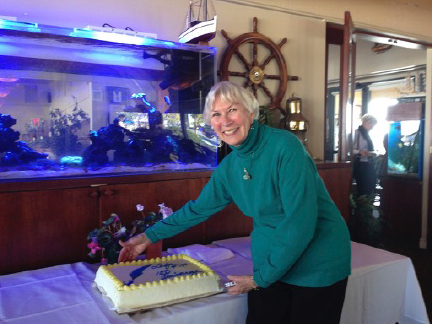 Marie-Ann cutting the cake for Tegner Lodge’s 100th Anniversary Celebration in 2008
 -
Marie-Ann’s biological father, John Hilding Hanson, was a Mormon missionary in Jönköping, Sweden. He probably met her mother, Anna Doris Adele Anderson, at a church social there. He already had a wife and children in America when he invited Anna Doris, 26, to immigrate and settle in Salt Lake City (plural marriages were frowned on in Sweden so it is not clear whether anyone in Sweden knew about his other wife). Anna Doris’s brother, Anders David Christian Anderson, left Sweden around the same time and they arrived in Salt Lake together.
Marie-Ann’s father owned a shoe store in Salt Lake City. When he returned, he married Anna Doris in 1930; and Marie-Ann was born in 1932. The shoe store failed, and Hanson moved to Los Angeles where he started another family. Marie-Ann has half-siblings whom she has never met. For all the years following, her father never sent her mother any financial support or tried to keep in touch with Marie-Ann. The Great Depression set in, bringing stress on families and single mothers across the country. -
Anna Doris got a job as a maid in a house with only one day off a month. Lacking access to childcare, she took Marie-Ann to live with a Swedish Mormon family by the name of Grass who helped immigrants get started in the U.S. Marie-Ann remained with them until she was 4 years old. Although the Great Depression put a strain on the adults, the Grasses had four children and Marie had a great time living with them.
Mr. and Mrs. Grass (Marie-Ann doesn’t know their first names) had three daughters, Vera Sophia, Ethel and Mabel. Marie-Ann thought of them as her cousins, and called Mrs. Grass’s mother “Mormor.” Marie-Ann was in Mormor’s care while the older girls were in school. Mormor taught Marie-Ann Swedish.
Marie-Ann remembers finding a safety pin and scratched family names into the piano bench. Mrs. Grass was very angry. Anna Doris was afraid Mrs. Grass would make her leave but things worked out. Marie-Ann didn’t know or fully acknowledge her mother, who could see her only once a month. One day when Anna Doris told Marie-Ann, “We are going to San Francisco,” Marie-Ann thought they were just taking a day trip and didn’t realize they wouldn’t be returning to Salt Lake City. The year was 1936. They packed their suitcases and took the train to Oakland.
From Oakland, they caught the ferry that went across the bay to San Francisco. There they took a streetcar to Russian Hill to stay with Marie-Ann’s Uncle David and his wife Vera. They had married in Salt Lake and left for San Francisco before Marie-Ann and Anna Doris arrived - an important aspect of the immigrant experience in which a family member or friend is the first to arrive at a location then beckons others to follow and provides support and assistance in transitioning to a new life.
That year the Bay Bridge opened (the Golden Gate Bridge opened six months later) and Marie-Ann was very excited to go across it. She remembers that it cost 25 cents.
Again, her mother found childcare through her Swedish connections. Anna Doris dropped off Marie-Ann at the Birgers before going to work. Daniel Birgers was a staff member at the Swedish newspaper Vestkusten until he was offered a position back east and the family left. The Birgers’ son Ibsen and daughter Sandra loved to jump out and scare Marie-Ann in the long, dark hallway of their big house. She remembers that Daniel once told Marie-Ann: “If you eat the crusts, you will grow up to be a policeman.” Sometimes we remember the oddest details. -
Marie-Ann was cute and learned to play several instruments, so she would entertain at events. She sang at the World’s Fair with her mother. Once her mother performed as a soloist and Marie-Ann sang with her. She got a bad case of stage fright, but did it anyway, she was so excited to be with her mom. She remembers singing “Little Sir Echo” and “It’s a Sin to Tell a Lie.” Supposedly there is a recording of her singing somewhere.
She and her mom lived with the Birgers for about a year. Her mom was working as a waitress for a company that had a cafeteria. Anna Doris was being courted by several men, including Eric Waldemar Larsson, who owned a fancy car. They probably met through VASA, and when they married, Marie-Ann came to think of her stepdad as her father. Eric’s family was well-off and owned vast forests around Dalarna, where Eric was born. He arrived in San Francisco in 1927, drawn by the lure of adventure. He had been accepted by a major university in Sweden to study mathematics, and his family was angry that he decided to leave for the U.S.
The family moved to Richmond to get jobs during the war. They were still members of Tor Lodge and went to San Francisco for lodge meetings. The family bought a house in Richmond, but life was still a struggle. Her mother worked and took in a border when Marie-Ann was around 11. During the war her mother worked in the shipyards. She was a rat proofer, putting linings in the seams of pipes. Her dad worked there, too, as a craftsman.
The family then moved to Sacramento and Marie-Ann went to Sutter Jr. High. Her father had saved some money and was planning to start a business … but his partner absconded with the funds. After weathering that setback, her dad eventually got a contractor’s license and started working on homes. In Sacramento, Marie-Ann worked for Weinstock Lubin Department Store at the lunch counter after school. Most of her earnings went to the family.
Everyone worked. Marie-Ann’s family moved from place to place in Sacramento. In the 1950s Marie-Ann met her first husband, an industrial engineer. They divorced in 1956.
Marie-Ann kept working in the retail business. A business connection introduced her to Phil Hill in downtown Oakland, they fell in love and eloped. Phil’s parents gave them the house in Oakland where they lived until their daughter Janel was ready to go to school. They moved to Piedmont, and raised their children Alison, Stuart, and Janel there.
Janel was named for Swedish sculptor Emil Janel. Alison and Stuart were adopted, and a Vietnamese boy Toke was also party of their family, a tribute to Marie-Ann’s generous heart. The family owned the successful Hill Shoes store in downtown Oakland where Marie-Ann sold shoes, did the accounting and made the window decorations. Marie-Ann went back to school and got a degree in cognitive psychology then a master’s with an emphasis in learning disabilities.
Marie-Ann and Phil divorced in 1978. She was active in Oakland’s Tegner Lodge #149 for many years, always ready with lovely table decorations for dinners and helping in so many ways. She also served as past Chairperson of Tegner.
In 2007, Marie-Ann was singing again, this time as a soprano with the Berkeley Community Chorus and Orchestra. She had previously sung with the Oakland Symphony Chorus under Joe Liebling, with whom she stayed in touch.
In 2012, Marie-Ann was instrumental in securing the $15,000 grant from the Barbro Osher Foundation for the Swedish History of the East Bay Project. She and I shared duties, and we took many field trips around Oakland and Berkeley to visit archives, take photos and conduct interviews. This interview with her was intended to illustrate how many individuals and Swedish connections helped newcomers adapt to a new life in a new land.
For the past few years Marie-Ann has lived in Lincoln Retirement Villas in Fremont, California. If you visit, which she would love, you will find her strolling the halls, spreading good cheer —sharing her smile and inquiring how others are doing. Happy Birthday, Marie-Ann Hill! -
Kitty Hughes (Tegner Lodge #149)
-
-